





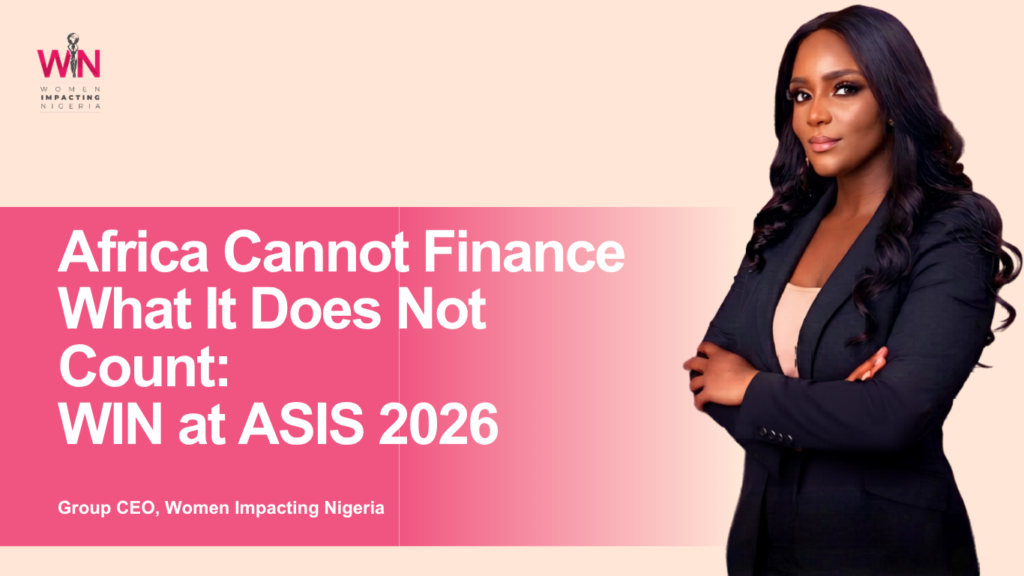
Lagos, July 2026 The Africa Social Impact Summit returns to the Eko Convention Centre from 22–24 July 2026 under the theme “Financing for Development: Building Resilience and Transforming Emerging Economies.” Co-convened by the Sterling One Foundation, the United Nations in Nigeria, and the Federal Ministry of Budget and Economic Planning, ASIS has, since 2022, become one of the continent’s most consequential rooms for development capital.
Women Impacting Nigeria (WIN) will be in that room. We are going with a position, and it is an uncomfortable one: Africa’s development finance problem is not only a capital problem. It is a counting problem.
“There is real money in this room and real will behind it. What is missing is the evidence base to direct it. Nigeria cannot allocate gender-responsive capital without gender-disaggregated data, and right now, that data largely does not exist. Building it is the most useful thing we can do for the capital already committed.”
— Adesuwa Imasekha, Founder and President, Women Impacting Nigeria
The Gap Behind the Gap
Every financing-for-development conversation begins with a number: the trillions Africa needs to meet the Sustainable Development Goals. That number is real. But it obscures a quieter failure.
Capital allocates towards what it can measure. Where there is no baseline, there is no target. Where there is no target, there is no accountability. And where there is no accountability, there is no risk in leaving people out because their exclusion never appears in a report.
This is precisely the position of the majority of Nigerian women. Not opposed, not debated, not deliberately excluded. Simply unenumerated. The rural trader, the semi-urban tailor, the woman running a business from her front room in a local government area no survey has visited in six years; she is invisible to the instruments designed to serve her. She is a rounding error in national metrics.
You cannot close a gap you have not measured. And you cannot pretend gender-blind capital is neutral capital.
What WIN Is Building Instead
1. Community Clusters Across 37 Locations
WIN operates Community Clusters across all 36 states and the Federal Capital Territory, each managed by a dedicated Cluster Lead who lives in the community she serves. The Clusters do two jobs that are usually separated and should never be.
They deliver. Financial literacy, reproductive health resources, digital access, and trade skills placed directly into rural and semi-urban communities rather than announced at them.
They count. Every Cluster Lead is a data node. Gender-disaggregated community data, gathered continuously by people the community already trusts, documenting the actual needs of women who fall through the gaps of mainstream systems.
This is the part most development architecture gets backwards: the same footprint that serves is the footprint that measures. Delivery without measurement produces anecdotes. Measurement without delivery produces extraction. We do not accept either.
2. The WIN Institute for Gender Data & Development
Our Cluster data feeds a permanent national asset: a Gender Data Bank, and an annual WIN Nigeria Gender–SDG Index & Report that will do for gender outcomes what credit ratings do for sovereign risk, make performance visible, comparable, and impossible to quietly ignore.
The purpose is not to publish. The purpose is to give investors, ministries, and development partners something they currently lack: a defensible baseline for gender-responsive capital allocation in Nigeria.
3. The WIN Academy
A structured 12-month skills and leadership journey for women and girls, built around digital literacy, financial capability, leadership development, and business innovation.
The Academy exists because pipeline arguments are usually excuses. When capital declines to reach women-led enterprises, the reason offered is readiness. Fine. We are building readiness at scale, and then we intend to hold the other side of that argument to its word.
What “Resilience” Should Mean at ASIS 2026
Resilience has become a comfortable word. It should not be.
For a woman running a micro-enterprise in Rivers or Kano, resilience is not a policy attribute. It is the distance between a health shock and destitution. It is whether her savings survive a currency move. It is whether her daughter stays in school when the harvest fails.
Financing that builds resilience for institutions but not for households has not built resilience. It has relocated risk downward, onto the people least able to absorb it, and disproportionately unto women, who function as the informal social safety net across most of this continent and are compensated for it exactly nowhere.
“Ask any resilience framework a simple question: when the shock lands, who absorbs it? In Nigeria, the honest answer is almost always a woman uncounted, unfunded, and then described in the report as community coping capacity.”
Three Asks for the Room
WIN is bringing three specific requests to ASIS 2026.
1). Make disaggregation a condition. Any capital deployed against an SDG target in Nigeria should report outcomes disaggregated by gender as a term of the facility, not as a footnote in the impact appendix. If it cannot be measured by gender, it should not be claimed as gender impact.
2). Fund the measurement layer, not only the programme. Data infrastructure is treated as overhead. It is not. It is the precondition for every allocation decision that follows. A development ecosystem that funds a hundred pilots and zero baselines will produce a hundred unverifiable success stories and no progress.
3). Put women in the design phase, not just the beneficiary column. Lived experience reveals gaps that do not appear in boardrooms, reports, or investment decks. Bringing women in at implementation is not inclusion. It is a consultation theatre performed after the decisions are made.
Partner With WIN
ASIS 2026 will produce commitments. The question that matters is which ones survive the summit.
Investors and development partners: partner with us to scale the WIN Academy, or to sponsor regional Community Clusters and the data infrastructure behind them. → Partnership@womenimpactingnigeria.org
Women and girls aged 18–40: applications for the WIN Academy cohort are open. → https://bit.ly/4a4wyCH
State representatives and community organisers: connect with your Cluster Lead to build measurable, localised impact in your state. → https://forms.gle/LwbKjeNiNrnvbuyF6
Africa’s development challenges require collaboration. But collaboration must be intentional, inclusive, and connected to the realities of the people it seeks to serve. Our message at ASIS 2026 is simple: count women, then fund them. In that order.
Frequently Asked Questions
Gender-responsive financing is capital allocation that explicitly measures and accounts for who benefits, disaggregating outcomes by gender rather than assuming that gender-neutral deployment produces gender-neutral results. Without disaggregated data, financing tends to reproduce existing inequalities by default.
WIN is attending to show that Africa’s financing gap is compounded by a gender data gap, and to present its Community Cluster network and Gender Data Bank as infrastructure for evidence-based, gender-responsive capital allocation in Nigeria.
The WIN Academy is a 12-month skills, leadership, and entrepreneurship programme from Women Impacting Nigeria for women and girls covering digital literacy, financial capability, leadership development, and business innovation.
WIN Community Clusters are localised hubs across all 36 Nigerian states and the FCT, each run by a Cluster Lead. They deliver skills, health resources, and financial literacy directly to women, and gather gender-disaggregated community data.
Partners can scale the WIN Academy, sponsor regional Community Clusters and the data infrastructure behind them, or collaborate on gender-inclusive advocacy and policy research.
Written by: Founder, Women Impacting Nigeria- Adesuwa Imasekha.