





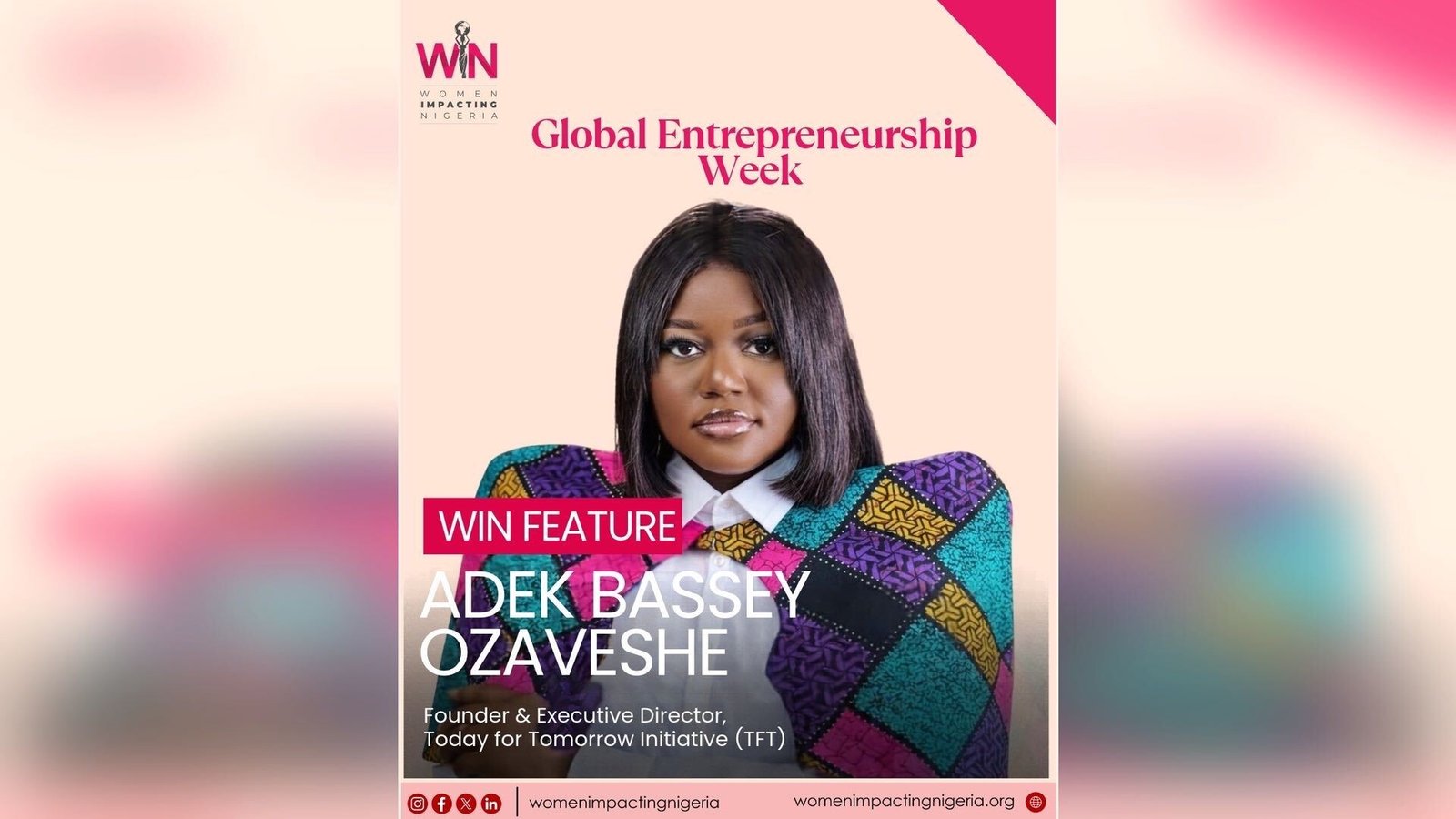
Every meaningful initiative begins with a reason. Sometimes, that reason is a problem that needs solving, an opportunity waiting to be created or a gap that can no longer be ignored.
For Adek Bassey Ozaveshe, it was the lack of access to accurate information and guidance among young people that inspired her entrepreneurial journey.
In 2016, she founded Today for Tomorrow Initiative (TFT), a youth-focused nonprofit working across youth development, public health, gender equality and community impact. What started with five passionate individuals has grown into an organisation with a broader vision for helping young people make informed decisions and build better futures.
With over 15 years of experience, more than ₦200 million mobilised in resources and over 5,000 young professionals mentored, Adek’s journey reflects the commitment, resilience and clarity required to build an institution.
As part of Global Entrepreneurship Week, WIN speaks with her about the inspiration behind TFT, the realities of building an organisation and her advice to women pursuing their entrepreneurial ambitions.
Meet Adek Bassey Ozaveshe
Adek Bassey Ozaveshe is a Nigerian social innovator, public health professional, youth development strategist, entrepreneur and consultant.
She is the Founder and Executive Director of Today for Tomorrow Initiative (TFT), Director and Lead Technical Expert at TFT–Today Skill Hub, and National Coordinator of AfriYAN Nigeria.
Through her work in youth development, public health and gender equality, she has mobilised over ₦200 million in resources and mentored more than 5,000 young professionals. She also supports individuals and organisations through her consultancy and Identity & Clarity Coaching practice.
Connect: @adekbassey across social media platforms.
Learn more: Today for Tomorrow Initiative | TFT–Today Skill Hub
THE CONVERSATION
1. What inspired you to start Today for Tomorrow Initiative, and what was the vision you hoped to bring to life?
My inspiration came from the huge gap I observed in young people’s access to accurate information to help them make informed decisions about their lives.
Growing up, I experienced how the absence of proper guidance could influence important decisions, including my own choice of career. I also saw young people in my community navigating issues such as unintended pregnancies, drug use and transactional sex without the information and support they needed.
I began providing information on HIV prevention, sexual and reproductive health, education and personal development even before 2016.
One experience, however, changed everything. I had a conversation with a young man who had given up on education and was involved in activities negatively affecting his life. Through our conversation and the support I offered, he decided to obtain a Direct Entry admission form and return to school.
When he asked why I had chosen to help him, I explained that helping young people access the information and support they needed to build their today for tomorrow was what I wanted to dedicate my life to.
He encouraged me to bring together others who had witnessed the work I was doing so we could reach more young people. That conversation birthed Today for Tomorrow Initiative.
We started as five passionate individuals and gradually grew. In 2019, our team collectively contributed resources to formally register the organisation because we needed an institutional structure to receive support and expand our work.
I did not start with the ambition of building an institution. I simply wanted to help young people access opportunities, make informed decisions and build better futures for themselves.
2. What has been one of your biggest challenges in building the initiative, and how have you navigated it?
One of my biggest challenges has been building and sustaining the right team. Finding people with the technical skills to deliver projects is one thing; finding people who genuinely believe in the vision and are committed to building the institution beyond individual projects is another.
Over the years, I have realised that some people are attracted to the opportunities and career benefits an organisation offers. However, when a project ends or they achieve their personal career objectives, their priorities and commitment sometimes change.
To navigate this, we have become more intentional about recruitment, engagement and team evaluation. Beyond technical competence, we assess candidates’ values, interests and alignment with our vision. We also have a passion assessment as part of our recruitment process.
I believe commitment cannot be fully established during an interview. You have to observe people over time. Our first three to six months of engagement help us understand their strengths, interests and working attitudes.
We also conduct periodic evaluations that consider teamwork, initiative, organisational culture and willingness to support others, not just individual deliverables.
It is still a learning process, but it has taught me that building an institution requires patience, discernment and the courage to make difficult leadership decisions. I believe the right team can build something that outlives its founder, and that is the kind of institution I am working towards.
3. What advice would you give to other women looking to start or grow their own businesses or initiatives?
My advice is to ensure that whatever you are building comes from a place of personal vision, clarity, conviction and purpose alignment.
Do not start something simply because other people are doing it or because it is trending. Let it come from a genuine understanding of who you are, what you believe in and the difference you want to make.
There will be difficult seasons, unexpected challenges and moments when everything seems to be falling apart. But when your foundation is rooted in personal conviction rather than external validation, you are more likely to find the resilience to keep building.
Clarity also creates room for creativity and innovation. It helps you develop strategies that are peculiar to your vision instead of constantly copying what others are doing. You become more intentional about your decisions, growth and the legacy you want to create.
Ultimately, don’t just build something because it looks good to have. Build something you believe in, something aligned with who you are and something you can see yourself nurturing into a lasting legacy.
WIN celebrates Adek Bassey Ozaveshe and the work she continues to build through Today for Tomorrow Initiative and TFT–Today Skill Hub.
As we mark Global Entrepreneurship Week, her journey reminds us that entrepreneurship is not only about starting something. It is also about having the clarity, conviction and commitment to keep building.