



Every year, World Population Day invites the world to reflect on people, growth, development, and the future of societies. Often, these conversations begin with numbers: population size, birth rates, maternal mortality, age distribution, fertility rates, household data, and development projections. But behind every number is a person. Behind every statistic is a family, a community, a dream, a decision, and a future. And very often, behind these population conversations is a woman whose health, choices, dignity, and opportunities must not be ignored.
At Women Impacting Nigeria (WIN), we believe that population discussions must go beyond counting people. There must be a deliberate focus on the quality of life people are able to live, the choices women are able to make, the healthcare they can access, and the support systems available to them.
Beyond the Statistics: Tracking Reproductive Health in Nigeria
Population data is crucial for planning, policy, development, and resource allocation. It helps governments, institutions, and development partners understand where people live, what services are needed, and how communities are changing. However, population data becomes fundamentally incomplete when it does not reflect the lived experiences of women.
Women are core to the dynamics of fertility, childbirth, household size, and demographic growth. They are navigating complex real-life conditions every day. Many women make daily choices regarding their health and wellbeing under restrictive circumstances.
Some are forced to make life-altering decisions with limited access to accurate reproductive health information. Others are balancing motherhood with education or work, while many face severe health risks without adequate maternal care. Too many women are raising families in remote communities where basic healthcare services remain incredibly difficult to access.
This is why World Population Day must be a clear call to examine women’s health, women’s agency, and women’s access to opportunity. Reproductive health and maternal care shape families, influence community wellbeing, affect economic participation, and determine how fully women can live, lead, and contribute to the nation.
Why Family Planning and Maternal Care Shape West Africa’s Economy
Reproductive health is intrinsically tied to knowledge, dignity, choice, and agency. When women and girls have access to accurate reproductive health information and quality medical services, they are equipped to make better decisions about their bodies, their wellbeing, and their future. This autonomy directly extends to their education, career planning, financial stability, family wellbeing, and participation in community life.
Family planning, when accessible and understood, gives women and families the ability to navigate their future with greater clarity and confidence. It allows women to plan their education, pursue sustainable work, build businesses, care for their families, and participate more fully in society.
This is fundamentally an economic issue. A woman’s ability to make decisions about her reproductive health directly influences whether she stays in school, when she enters or returns to the workforce, how she manages household responsibilities, and how she builds financial independence. Women’s health is therefore directly connected to women empowerment and sustainable development.
No nation can speak seriously about development while treating women’s health and choices as secondary. If the goal is sustainable development, then there is an urgent need for women to have access to the information, healthcare, opportunity, and support required to make decisions that affect their lives.
Bridging the Healthcare Gap: WIN’s Grassroots Community Clusters
We refuse to let these women remain mere statistics or rounding errors in national reports. To turn these conversations into tangible action, Women Impacting Nigeria operates a localized infrastructure designed to reach the unreached.
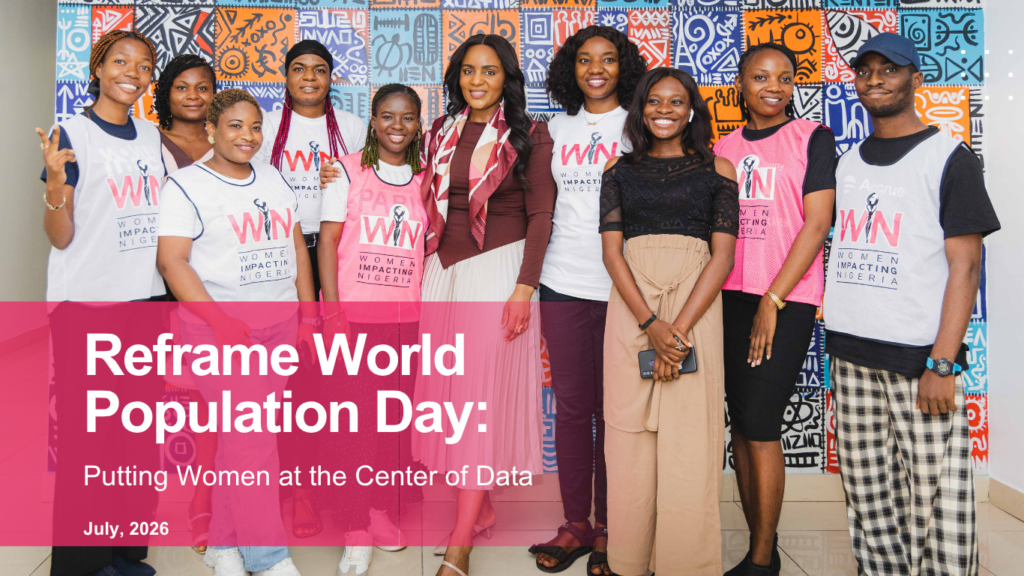
Through our WIN Community Clusters, which span across all 36 states and the Federal Capital Territory (FCT), we do 2 things:
–Reach the unreached. Each cluster delivers financial literacy, health resources, and trade and digital skills directly into local communities, person to person, where national programmes seldom arrive.
–Count the missed. By putting a permanent grassroots footprint in every state, we can document, map, and understand the vulnerabilities and the economic potential of women who fall straight through the gaps in conventional data.
WIN’s Commitment: Placing Women at the Centre of Development Conversations
Women Impacting Nigeria continues to advocate for a society where women have the tools, knowledge, platforms, and opportunities to make informed decisions and participate fully in national development. Across our community-driven initiatives, advocacy efforts, programmes, and platforms, WIN continues to create spaces where women are not treated as passive beneficiaries but as active voices, leaders, builders, and contributors to sustainable development.
Population conversations must include women’s realities. Health conversations must include women’s dignity. Development conversations must include women’s choices. Economic conversations must include women’s agency. This is the perspective WIN brings to national conversations: women must not only be counted; they must be heard, supported, protected, and empowered.
Conclusion: Every Number Deserves Dignity
World Population Day is not only a day to reflect on global figures. It is a day to remember that every statistic represents a human life. Every maternal health figure represents a woman who needs care. Every family planning statistic represents a woman or family making decisions. Every reproductive health gap represents someone whose future may be affected. Every development target represents real communities waiting for better systems. Every number is a woman with a name, a voice, a body, a family, a dream, and a future.
If we want stronger communities, we must invest in women’s health. If we want sustainable development, we must support women’s choices. If we want inclusive growth, we must create systems that protect women’s dignity and expand women’s opportunities.
On this World Population Day, WIN calls for continued action, deeper conversations, and stronger commitments to women’s health, dignity, and opportunity. Because every number is a woman. And every woman matters.
Frequently Asked Questions
While global population conversations often focus heavily on macroeconomics and demographics, true population development must center on women’s health, choices, and dignity. In Nigeria, improving reproductive health and maternal care access is critical to shifting national development metrics.
Access to family planning allows women to make informed choices about their bodies and family sizes. This directly influences their ability to complete their education, enter or remain in the workforce, build financial independence, and break cycles of poverty.
WIN Community Clusters are localized grassroots networks operating across all 36 states of Nigeria and the FCT. They deliver essential financial literacy, health resources, and digital skills directly to underserved women, ensuring that those outside formal financial and health systems receive vital support.
WIN believes that what is not measured cannot be fixed. By utilizing our grassroots networks, we gather localized health and socio-economic data on women who are often missed by broad national censuses, allowing us to advocate for better policy design and targeted healthcare interventions.
About Us: Women Impacting Nigeria (WIN) is West Africa’s largest grassroots women’s humanitarian organisation, operating across all 36 states of Nigeria since 2010 to advance sustainable development through the pillars of health, education, and economic empowerment.