



The number that should reframe how Nigeria plans for development
There is a single statistic that ought to change how policymakers, economists, and development organisations plan in this country. According to UN Women and the World Bank, for every 100 men aged 25 to 34 living in poverty worldwide, there are 122 women.
Poverty, in other words, is not gender-neutral. It is disproportionately female. And the picture is sharpest exactly where we work: of every world region, sub-Saharan Africa carries the widest gender poverty gap of all. Nigeria does not sit at the edge of this reality. We sit at its centre.
At Women Impacting Nigeria (WIN), we treat that figure not as a talking point, but as a mandate. Behind it are real women, petty traders, smallholder farmers, young mothers, girls pushed out of school and our work begins where their names stop appearing in the data.
Gender equality is not one goal. It runs through all seventeen.
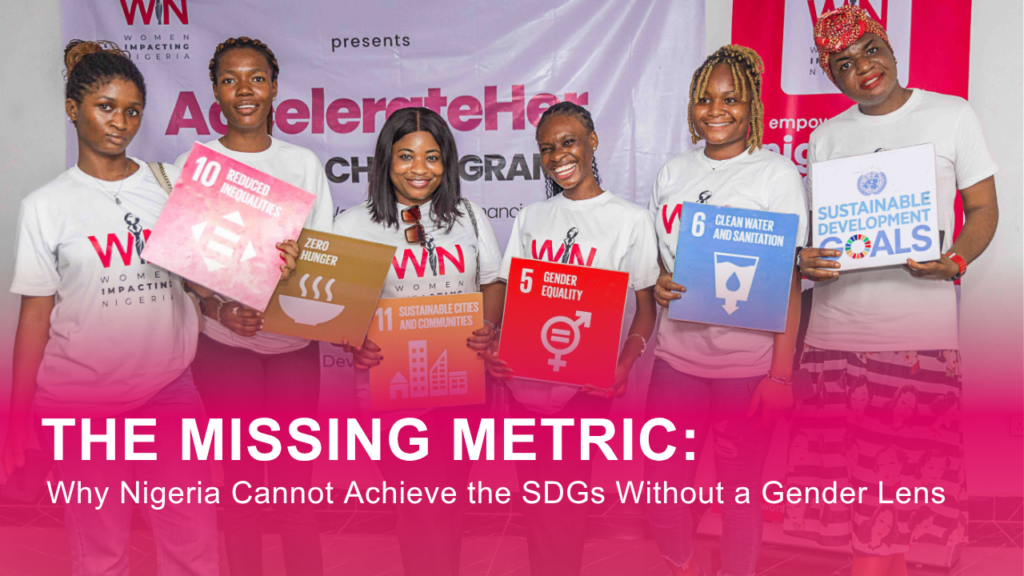
It is common to read the United Nations Sustainable Development Goals as a checklist of separate targets, and to treat SDG 5 (Gender Equality) as one box among seventeen. We see it differently.
Gender equality is not a pillar standing beside the others. It runs through the entire architecture of every Goal. You cannot end hunger (SDG 2) while women farmers are denied land, credit, and inputs. You cannot deliver quality education (SDG 4) while girls leave school first when a household runs short. You cannot build decent work and economic growth (SDG 8) while women are concentrated in unpaid care and informal trade. Pull the gender thread, and the whole fabric of the 2030 Agenda comes loose.
This is why a gender lens is not an optional refinement to development planning in Nigeria. It is the difference between a plan that works and a plan that quietly leaves half the population behind.
The danger of what we do not measure
In development, one rule holds without exception: what is not measured cannot be fixed.
When national statistics are not broken down by sex, age, and locality, the specific barriers facing women become invisible — and invisible problems do not get funded, designed for, or solved. The Sustainable Development Report tracks Nigeria’s progress on gender across measures like the ratio of women to men in the labour force, the gap in years of education, demand for family planning met by modern methods, and the share of seats women hold in parliament. These are the right questions. But headline national indicators rarely reach the women who most need to be counted: those in rural and semi-urban communities, outside formal financial systems, beneath the resolution of mainstream data collection.
Without gender-disaggregated data, interventions stay broad, blunt, and inefficient — generous in intention, weak in effect. The feminization of poverty persists not only because of what we fail to do, but because of what we fail to see.
Counting the uncounted: WIN’s Community Clusters
We refuse to let these women remain a rounding error. So we are building the structure to find them.
Across all 36 states and the Federal Capital Territory, WIN is establishing localised Community Clusters and they do two jobs at once.
They reach the unreached. Each cluster delivers financial literacy, health resources, and trade and digital skills directly into local communities, person to person, where national programmes seldom arrive.
They count the missed. By putting a permanent grassroots footprint in every state, we can document, map, and understand the vulnerabilities and the economic potential of women who fall straight through the gaps in conventional data.
In short, the same network that empowers women also makes them visible. Service and measurement become one act.
Building the instrument: the WIN Gender Data Bank
If the problem is unmeasured data, then the answer is not a single report, it is a permanent institution that measures.
That is why WIN is establishing the WIN Gender Data Bank, a dedicated research institute that reports on gender across Nigeria’s performance on the Sustainable Development Goals. Rather than treating gender as a footnote to national statistics, the Data Bank asks each of the seventeen Goals a direct question: how is this being met or missed for Nigerian women and girls?
Fed by evidence gathered through our Community Clusters, the Gender Data Bank turns grassroots reality into structured, credible, decision-grade data — the kind that governments, funders, and partners can actually plan and allocate against. It is how WIN moves the gender conversation from advocacy to evidence, and from evidence to accountability.
Putting it in her hands: the WIN App
Data must reach the woman it describes, not only the policymaker who studies her. So in late 2026, WIN will launch the WIN App, a single digital platform that puts our work directly into members’ hands.
Through the App, women will access funds, resources, and training; enrol in the WIN Academy; and participate in gender-vital reporting, contributing community-level data that flows straight back into the Gender Data Bank. It closes the loop between the woman on the ground and the institution that counts her: every member becomes both a beneficiary of the data and a builder of it.
Together, the Clusters reach her, the App serves her, and the Data Bank ensures she is never again missing from the metric.
A call to action
Closing Nigeria’s gender poverty gap will not come from rhetoric. It demands structured, deliberate, data-backed action at the local level. When we lift the women currently sidelined by poverty, we do not only advance SDG 5 we raise the economic baseline of entire communities, and of the nation itself.
The data is clear. The framework is built. What remains is collective will.
Share this data to shift the narrative and partner with Women Impacting Nigeria to invest in the data and the development that changes lives.
Frequently Asked Questions
The gender poverty gap describes the fact that women are more likely than men to live in poverty. Globally, UN Women and the World Bank find that for every 100 men aged 25–34 in poverty, there are 122 women and sub-Saharan Africa has the widest gap of any region.
Because what is not measured cannot be fixed. When data is not broken down by sex, age, and locality, the specific barriers facing women especially in rural and informal communities stay invisible, and interventions miss them.
The WIN Gender Data Bank is a research institute, Founded by Adesuwa Imasekha to report on gender across Nigeria’s performance on the UN Sustainable Development Goals, turning grassroots evidence into decision-grade data.
Launching in late 2026, the WIN App is a digital platform giving women access to funds, resources, training, and the WIN Academy, while enabling community-level gender reporting that feeds the WIN Gender Data Bank.
Women Impacting Nigeria (WIN) is West Africa’s largest grassroots women’s humanitarian organisation, operating across all 36 states of Nigeria since 2010.